
Many people with shoulder pain — and their families — share the same misconception: aching when lifting the arm, a swelling pain at night, and they call it all frozen shoulder, then start swinging the arm or forcing stretches up a wall on their own. Clinical data tell a different story: more than 60% of shoulder pain originates in a rotator cuff injury, and blind stretching keeps tearing the tendon — a mild strain dragged on until it becomes a full-thickness tear that finally has to be repaired surgically.
To help patients and families tell shoulder conditions apart, avoid the risks of the wrong exercises, and carry out home care and structured rehabilitation correctly, a recent rehabilitation lecture broke down the anatomy of the shoulder joint, how to differentiate the common causes of shoulder pain, and the full stepped pathway of standard treatment. If you missed the live session, this complete recap is worth bookmarking.

Why the Shoulder Joint Is So Vulnerable
The shoulder is the joint with the greatest range of motion and the least stability in the human body. Acromial impingement and tendon damage develop quietly, and the wrong exercises rapidly worsen soft-tissue damage — seriously affecting everyday basics such as dressing, combing your hair and lifting objects.
The shoulder complex is built from three bones — the humerus, the scapula and the clavicle — together with four joints: the glenohumeral, acromioclavicular, sternoclavicular and scapulothoracic joints. The spherical surface of the humeral head is three to four times the area of the glenoid socket, so the socket is shallow: naturally mobile, but inherently weak in stability, with tendons and bursae easily compressed and worn.
The shoulder stays stable through two sets of structures: ligaments, the joint capsule and the labrum form a static protective barrier; while the four rotator cuff muscles — supraspinatus, infraspinatus, teres minor and subscapularis — form a force couple with the deltoid. When rotator cuff strength is insufficient, the humeral head drifts upward and keeps rubbing against the acromion, causing pain.

Telling the Three Most Common Shoulder Conditions Apart
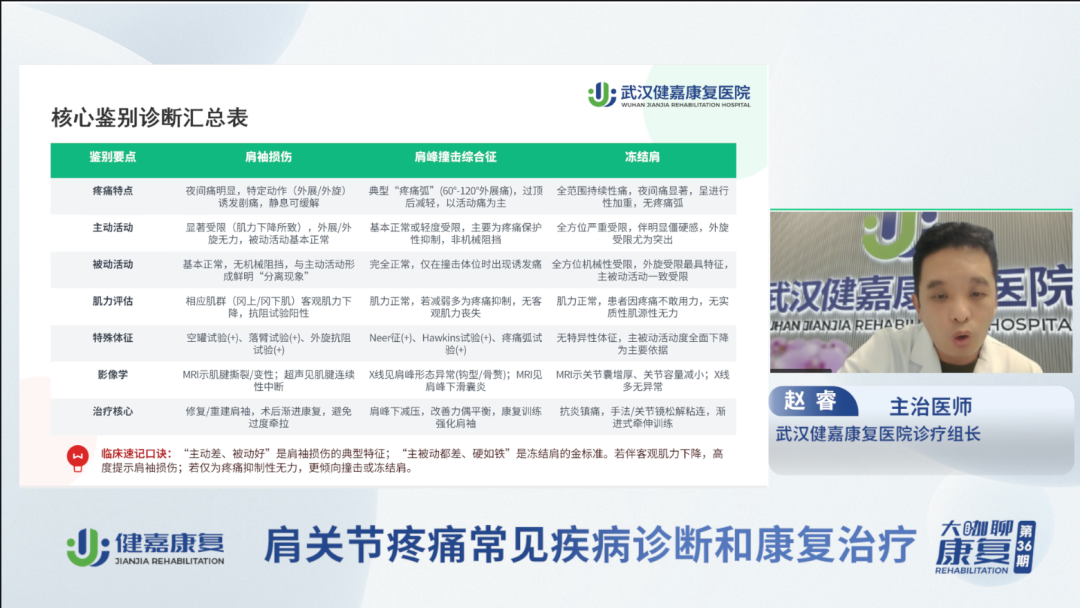
1. Rotator cuff injury (60% of all shoulder pain — the most common)
Typical signs: weakness when raising the arm under your own power, yet no obvious resistance when someone else moves the arm passively; severe night pain when lying on the affected side; a positive empty-can test or drop-arm test on examination.
Absolute contraindications: large-range arm swinging, loaded overhead lifting, and forceful stretching.
2. Subacromial impingement syndrome (20%)
Typical signs: a sharp pain when the arm is abducted between 60° and 120°, which eases once the arm is lifted overhead; common in badminton and swimming enthusiasts and in people who sit hunched at a desk for long hours; the Neer and Hawkins tests can provoke the pain.
3. Frozen shoulder (adhesive capsulitis, 8%)
Typical signs: stiffness and pain in every direction, both when moving the arm yourself and when someone else moves it, with restricted external rotation the most prominent limitation. The course runs in three phases: a pain phase (0–3 months), a stiffness phase (3–9 months) and a thawing recovery phase (9–24 months). Absolute contraindication: forcing the shoulder through its range or high-intensity stretching during the pain phase.
Stepped Treatment: Three Tiers, From Conservative Care to Surgery
Tier 1 — the acute phase: basic conservative treatment
The core goal is to reduce inflammation and pain and bring the local inflammation under control.
Medication: topical anti-inflammatory pain-relief patches or gels come first; for stubborn pain, local injections of corticosteroids or PRP (platelet-rich plasma) may be given as prescribed. Physiotherapy: for acute swelling, heat and fever-like pain, cold compresses and pulsed ultrasound are chosen; for chronic stiffness and aching, heat therapy and shockwave therapy are used to release adhesions.
Tier 2 — the subacute and chronic phase: condition-specific home rehabilitation training
Rotator cuff injuries follow a four-phase recovery:
- Weeks 0–4: wear a brace for protection and immobilisation, doing only gentle pendulum exercises.
- Weeks 4–8: begin scapular stability training and isometric activation of the rotator cuff muscles.
- Weeks 8–12: light elastic-band resistance training, progressively strengthening the rotator cuff.
- Week 12 onward: functional compound movements, gradually returning to daily activities.
Impingement correction training uses scapular push-ups to activate the serratus anterior, elastic-band external rotation to rebalance rotator cuff strength, and wall angels to correct rounded-shoulder posture — rebuilding a normal scapulohumeral rhythm and widening the space under the acromion to reduce tendon friction.
Frozen shoulder is exercised by phase: only small pendulum movements during the pain phase; slow towel stretches and cane exercises to gain range during the stiffness phase; strengthening of the scapular stabilisers during the thawing phase. Before stretching, imaging must first rule out a rotator cuff tear.
Tier 3 — surgical intervention and staged post-operative rehabilitation
Indications: no improvement after 3–6 months of structured conservative treatment, a full-thickness rotator cuff tear, recurrent dislocation of the shoulder, or severe capsular adhesion.
Post-operative recovery also follows four phases:
- Weeks 0–6: an abduction brace for protection, with passive joint movement only.
- Weeks 6–12: the brace is removed and the scapular stabilisers are activated.
- Weeks 12–24: full-range joint movement plus systematic strength building.
- Week 24 onward: sport-specific strength and functional recovery — premature loading that risks a second tendon tear is strictly forbidden.
Protecting Your Shoulder at Home: The Key Rules
- Do not mix up the care for rotator cuff injury and frozen shoulder: a rotator cuff injury is mainly protected and rested, while a frozen shoulder needs gentle, progressive stretching — the exercise programmes are complete opposites, and doing the wrong one makes the damage worse.
- The order of rehabilitation cannot be reversed: first correct rounded shoulders and a hunched back and stabilise the shoulder blade, then start arm-raising and stretching exercises.
- Know the red line of training sensation: only mild muscle soreness is acceptable. The moment sharp or radiating pain appears, stop training immediately.
- Daily prevention: avoid long hours of overhead work and slouching with a lowered head, and keep doing exercises such as back squeezes and wall angels to strengthen the muscles that stabilise the shoulder.

Individuals differ. This article is for general health education only and is not a substitute for medical advice. If you feel unwell, please visit a hospital promptly.