Roughly two million people in China have a new stroke each year, and between 70% and 80% of stroke survivors are left with a disability that prevents them from living independently. Modern rehabilitation theory and practice agree on one point: effective rehabilitation after stroke speeds recovery, reduces functional disability and reduces the burden on families and on society. With a growing population of people living with hypertension and with rapid population ageing, the incidence of stroke continues to rise.
The road back from stroke is long, and it is usually divided into consecutive stages. The first of these — the flaccid stage — is the foundation stone of the whole process, and the stage that most needs to be understood scientifically and handled with patience.
What Is the Flaccid Stage?
The flaccid stage covers roughly the first one to three weeks after onset, when vital signs are stable but muscle strength, muscle tone and tendon reflexes on the affected side are reduced.
The work of this stage is specific: use a range of methods to restore or raise muscle tone, elicit the first active movement of the limb, prevent complications and secondary damage, and prepare the body for the functional training that follows. The five areas below are the practical core of that work.
1. Positioning: Laying the Foundation for Everything Else
Early correct positioning, together with appropriate range-of-motion exercise, reduces complications, improves the quality of care and speeds recovery. Good positioning uses soft pillows to place the patient in a comfortable, antispastic alignment. Correct positioning should continue through every stage after hemiplegia, and the position should be changed regularly — generally once every two hours.
Lying on the affected side
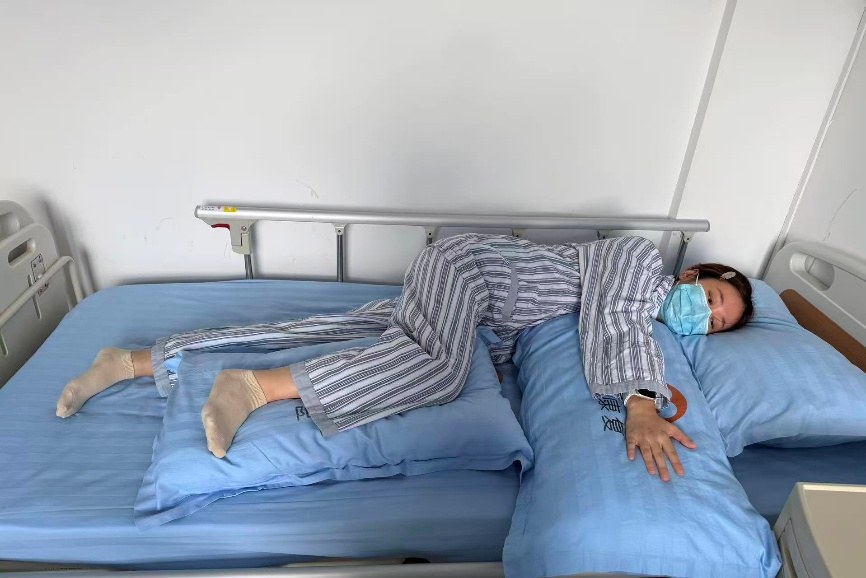
The affected side is underneath and the unaffected side on top. The head is supported on a pillow. The affected arm is abducted, brought forward and externally rotated, with the shoulder protracted as far as possible so that it is neither compressed nor retracted; the upper arm is externally rotated, the elbow and wrist extended, the palm facing up. The affected leg rests on the bed in slight flexion. The unaffected leg is flexed at hip and knee and placed forward over a long pillow, and the unaffected arm rests relaxed on a pillow across the chest or on the trunk.
Lying on the unaffected side
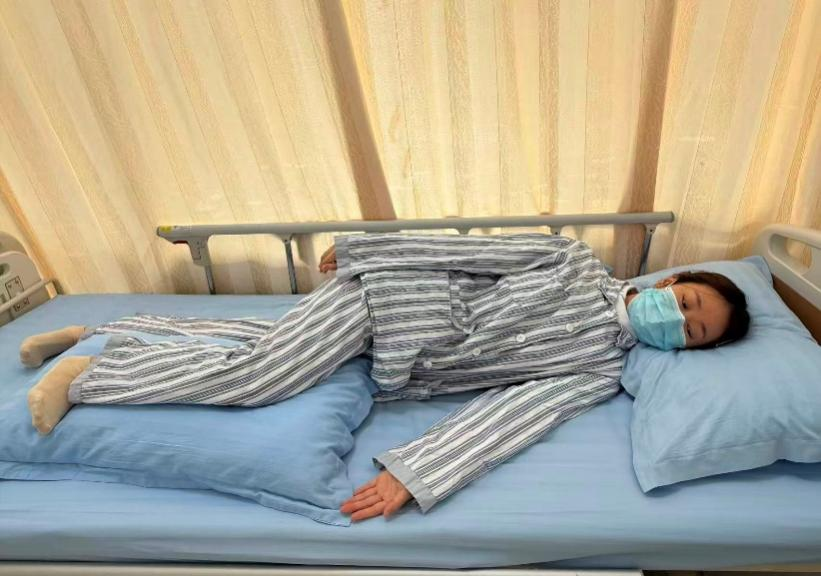
The unaffected side is underneath and the affected side on top. The head is supported on a pillow. The affected upper limb is extended and placed on a pillow so that the scapula is protracted forwards and outwards, the forearm pronated, the fingers extended and the palm facing down. The affected lower limb is brought forward with hip and knee flexed and is fully supported by pillows. Take care that the foot does not turn inward and hang over the edge of the pillow.
Lying on the back
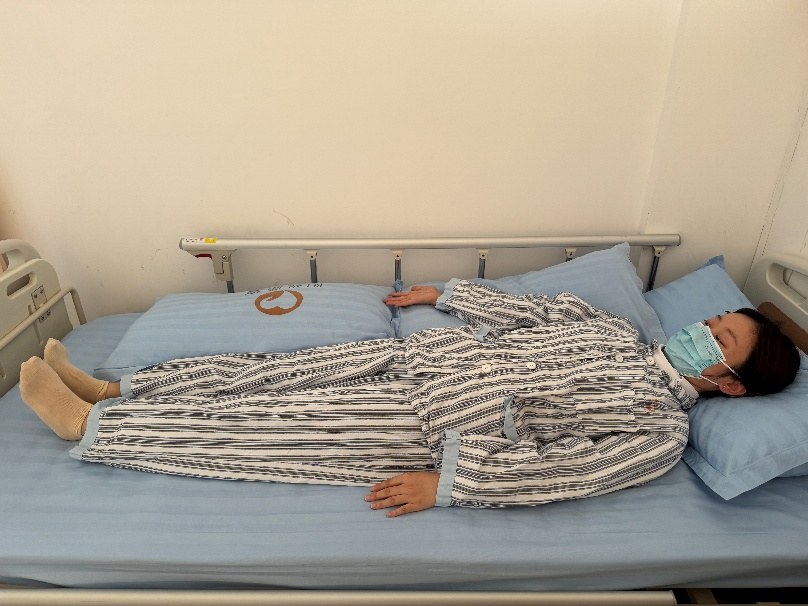
The head is well supported on a pillow. A long pillow is placed under the affected scapula and upper arm; the upper arm is externally rotated, the elbow and wrist extended, the palm up and the fingers extended, with the whole arm resting flat on the pillow. Pillows are placed under the affected hip, buttock and the outside of the thigh to prevent abduction and external rotation of the leg. The knee is slightly raised so that it stays extended with a slight bend.
Sitting up in bed
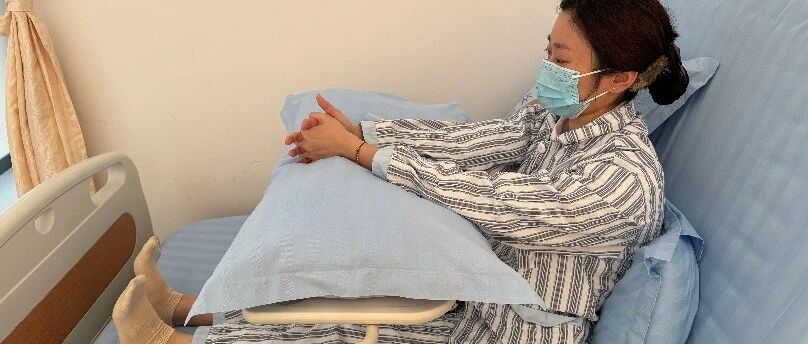
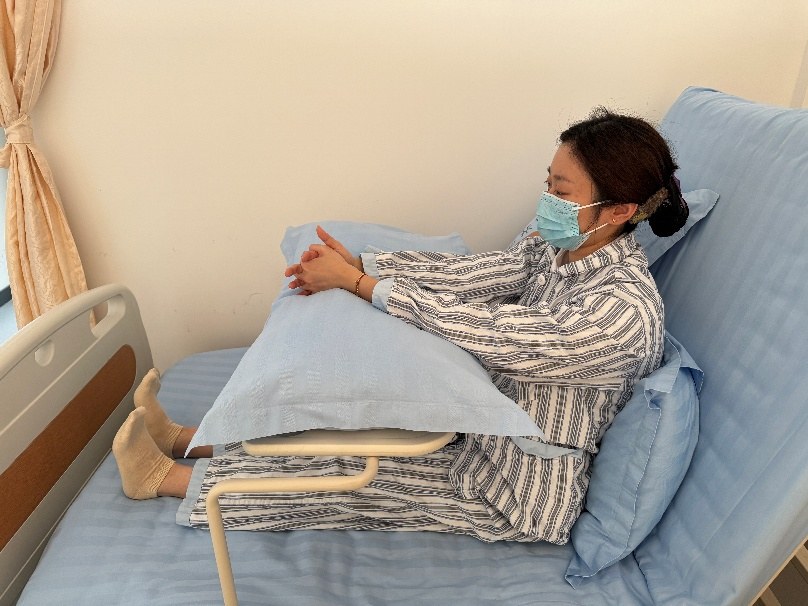
When the condition allows, the patient should be encouraged to sit up in bed as early as possible. Unsupported sitting in bed, however, rarely keeps the trunk upright: patients tend to slip into a semi-reclining position, which encourages trunk flexion and aggravates extensor spasticity in the lower limbs. Where there is no support, this position is best avoided.
For supported sitting, the hips are flexed to approximately 90 degrees, the back is fully supported so that the spine extends into an upright sitting posture, and the head is left unsupported so that the patient can actively control head movement. The affected upper limb is supported on a soft pillow; where available, an over-bed table with a pillow on it gives the arm a stable resting place.
2. Moving Around in Bed
Patients spend a considerable amount of time in bed early on, so bed mobility should be encouraged.
Moving sideways. The patient uses the unaffected leg: flexing it at hip and knee and hooking it under the affected leg, then bringing both legs across towards the unaffected side while using the head and buttocks as a support to shift the trunk.
Moving up and down the bed. The unaffected hip and knee are flexed with the foot flat on the bed; using the unaffected foot and the elbow as supports, the patient lifts the hips and moves the body upwards.
3. Passive Movement of the Limbs
Passive movement should be gentle, slow and rhythmic, without forceful techniques. Work from the proximal joint to the distal one: shoulder, elbow, wrist, hip, knee, ankle.
Done correctly, passive movement promotes blood and lymphatic return and reduces or prevents oedema; it enhances proprioception, helps prevent joint contracture and muscle wasting, relaxes spastic muscles and prepares the limb for active movement; and it stretches shortened tendons and ligaments, maintaining and restoring joint range of motion.
4. Sensory Stimulation and Early Activation
Families can place objects with different textures next to the patient to increase sensory awareness, elicit more movement and help the brain form new neural connections. Another simple option is to have the patient touch the affected limb with the unaffected hand or foot, attending to the sensation.
5. Breathing Exercises
Patients should be taught diaphragmatic breathing, pursed-lip breathing and abdominal breathing early on. Training the respiratory muscles and expanding the chest improves gas exchange, raises lung function, helps clear sputum effectively and prevents pulmonary infection.
Aerobic training — passive and active upper- and lower-limb work, and walking practice — can be added later to improve respiratory function further. Breathing training also reduces the severity of swallowing and speech difficulties, which makes it an indispensable adjunct.
Early Is Decisive, Persistence Is What Counts
Rehabilitation in the flaccid stage is won on the word “early” and valued for persistence. The aim is to make sure that flaccidity does not become an irreversible regret. Start early, train scientifically, cooperate actively — and let clinicians, nurses, families and the patient pull in the same direction, so that a stiff limb can regain its fluency and a dimmed daily life can find its light again.
This article is for general health education only and does not replace individualised medical advice. Positioning and exercise should be taught and checked by the treating rehabilitation team before being carried out at home.
References
[1] Liu Shuxian, Liu Liling, Fang Yufen. Effect of correct limb positioning combined with hemiplegic limb rehabilitation training on outcomes in cerebral infarction with hemiplegia. Integrated Traditional Chinese and Western Medicine Nursing, 2023, 9(4): 162-164.
[2] Liu Nan, Li Ka. Rehabilitation Nursing, 5th edition. Beijing: People's Medical Publishing House, 2022: 109-111.
[3] Xu Xuedi, Xu Xuemei, Chen Hemu, et al. Effect of neuromuscular electrical stimulation combined with Rood technique on upper-limb function in patients in the flaccid stage after stroke. Anhui Medical Journal, 2022, 43(9): 995-998.
[4] Zhang Shaolan, Wang Hongxing. Rehabilitation of Common Diseases, 3rd edition. Beijing: People's Medical Publishing House, 2019: 23-37.
[5] Chinese Medical Association Neurology Branch. Guidelines for Early Rehabilitation After Stroke in China. Chinese Journal of Neurology, 2017, 50(6): 405-412.