Preclinical research briefing. Everything described below comes from experiments in mice. Acetazolamide is not an approved treatment for opioid use disorder, and no human efficacy data are presented here. Never start or change a medicine on the basis of a research summary.
Relapse remains the central problem in opioid use disorder: craving can persist long after physical withdrawal, and a familiar cue can restart drug seeking. A study published in Neuropsychopharmacology in January 2026 asks whether those lasting changes in the brain's reward circuitry can be reversed by a drug that is already in clinical use for other conditions.
The team, led by John A. Wemmie at the University of Iowa, focused on carbonic anhydrase 4 (CA4) and on acetazolamide, a carbonic anhydrase inhibitor. We summarise the findings because the mechanism — synaptic remodelling after opioid withdrawal — is relevant to how long-term recovery is understood.
What the researchers tested
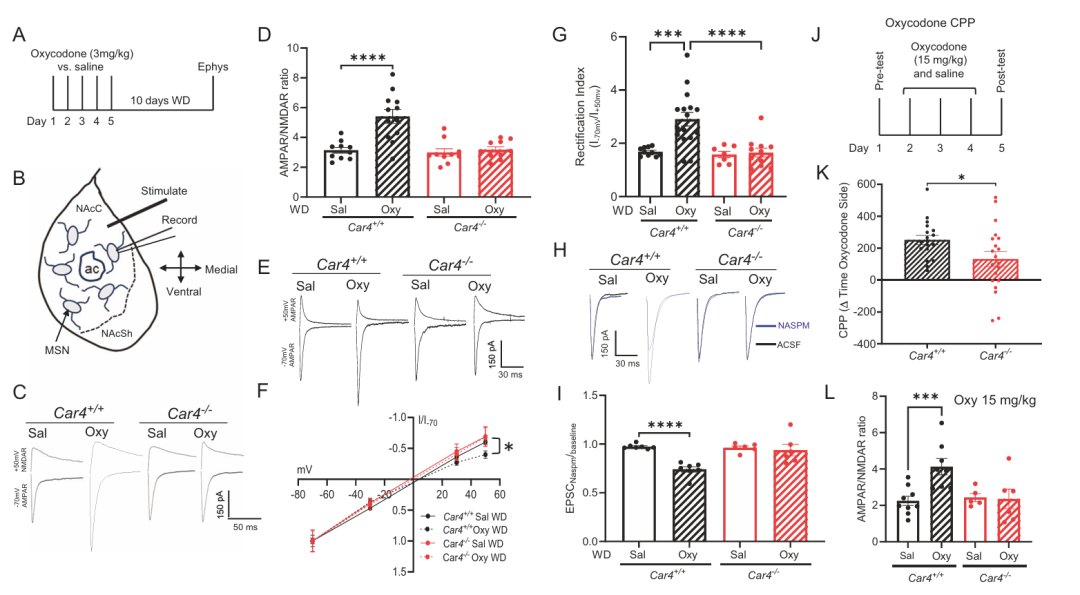
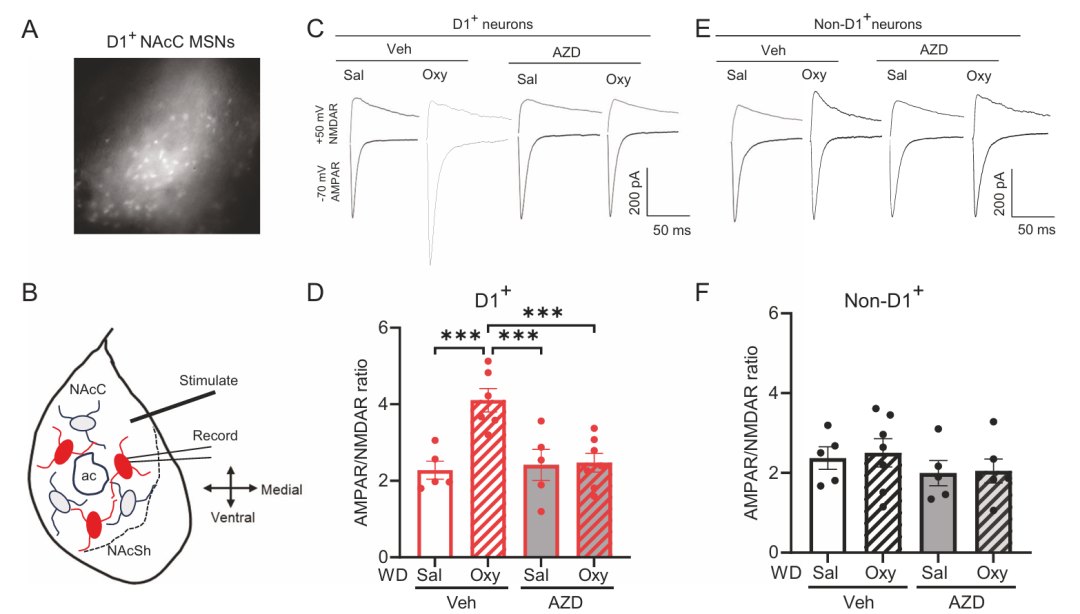
Mice received daily oxycodone or saline, followed by a withdrawal period. Patch-clamp recordings in the nucleus accumbens core measured the AMPAR/NMDAR ratio, a marker of synaptic strength, and tests with the antagonist NASPM detected calcium-permeable AMPA receptors. Conditioned place preference and intravenous self-administration were used to measure reward memory and drug seeking.
The main findings
| Question | Result in mice | Interpretation |
|---|---|---|
| Does opioid withdrawal change synapses? | The AMPAR/NMDAR ratio rose after prolonged withdrawal, specifically in D1-expressing medium spiny neurons, without a change in dendritic spine density. | Opioid withdrawal produces a functional, cell-type-specific synaptic change that differs from that seen after cocaine. |
| Is CA4 involved? | CA4 knockout mice did not show the withdrawal-induced synaptic change and had weaker conditioned place preference. | CA4 appears to be a key regulator of opioid-induced synaptic adaptation. |
| Can a drug reverse it? | Acetazolamide normalised the AMPAR/NMDAR ratio and NASPM sensitivity after withdrawal from oxycodone, morphine or heroin, with no effect in drug-naive mice. | The effect depends on prior opioid exposure and on the CA4 and ASIC1A pathway. |
| Does it reduce drug seeking? | After 30 days of abstinence, acetazolamide roughly halved cue-induced lever pressing; CA4 knockout mice showed similarly reduced seeking. | Targeting this pathway may reduce long-term craving behaviour in an animal model. |
The proposed CA4–ASIC1A pathway
In the authors' model, opioid exposure engages CA4, which interacts with the acid-sensing ion channel ASIC1A to reshape glutamate signalling in the nucleus accumbens. Blocking CA4 — genetically or with acetazolamide — prevented or reversed that remodelling and reduced seeking behaviour. The authors note that acetazolamide crosses the blood-brain barrier and has an established clinical safety profile from its existing indications, which could make translational studies faster to start.
Why this is not yet a treatment
All efficacy evidence here is from mice. Effective doses, treatment duration, safety in people with opioid use disorder, interactions with methadone or buprenorphine, and outcomes after real-world relapse cues are unknown. Acetazolamide should not be used for addiction outside a regulated clinical trial.
The study also used specific dosing and withdrawal schedules; a short 24-hour withdrawal did not produce the synaptic change, and a low heroin dose did not either. That sensitivity to protocol is a reminder that preclinical effects can be narrow, and that the leap from a lever-pressing test to a patient's recovery is substantial.
Relevance to rehabilitation practice
For rehabilitation teams, the useful idea is that the biology of craving may remain modifiable long after detoxification, and that non-opioid-receptor targets are being explored. It is a reason to follow the literature — not a reason to change clinical care. Established opioid use disorder treatment remains medication, psychological and social support delivered by qualified specialists.
Key takeaways
- Opioid withdrawal altered glutamate signalling in a specific neuron population of the mouse nucleus accumbens without changing spine density.
- CA4 knockout or acetazolamide reversed those changes and reduced cue-induced drug seeking in mice.
- The effect depended on both CA4 and ASIC1A, and on the dose and length of withdrawal.
- No human data are available; this is a potential research direction, not a therapy.
Source and editorial note
Independently written in English by the MedTourChina Rehabilitation editorial team, based on a Chinese-language research interpretation published by 脑声常谈 on 30 January 2026 and the paper "Acetazolamide inhibition of carbonic anhydrase 4 reverses opioid-induced synaptic rearrangements in nucleus accumbens and reduces drug-seeking behavior", Neuropsychopharmacology, 21 January 2026, DOI: 10.1038/s41386-025-02319-5. Figures are reproduced from that interpretation with attribution; rights remain with the original holders. This page is research information and is not medical advice.